


AI Fatigue Is Real - And Your Next Rollout Will Walk Right Into It
Your employees have been here before.
You called a company meeting. You showed them a demo. You told them this tool was going to change how they work. You had them sit through a two-hour training session on a Tuesday afternoon. And then - six months later - nobody was using it. The project quietly died. Nobody mentioned it again.
That was rollout number one.
Now you’re back. You’ve got a new AI tool. A better one. And you need your team to actually use it this time.
Good luck with that.
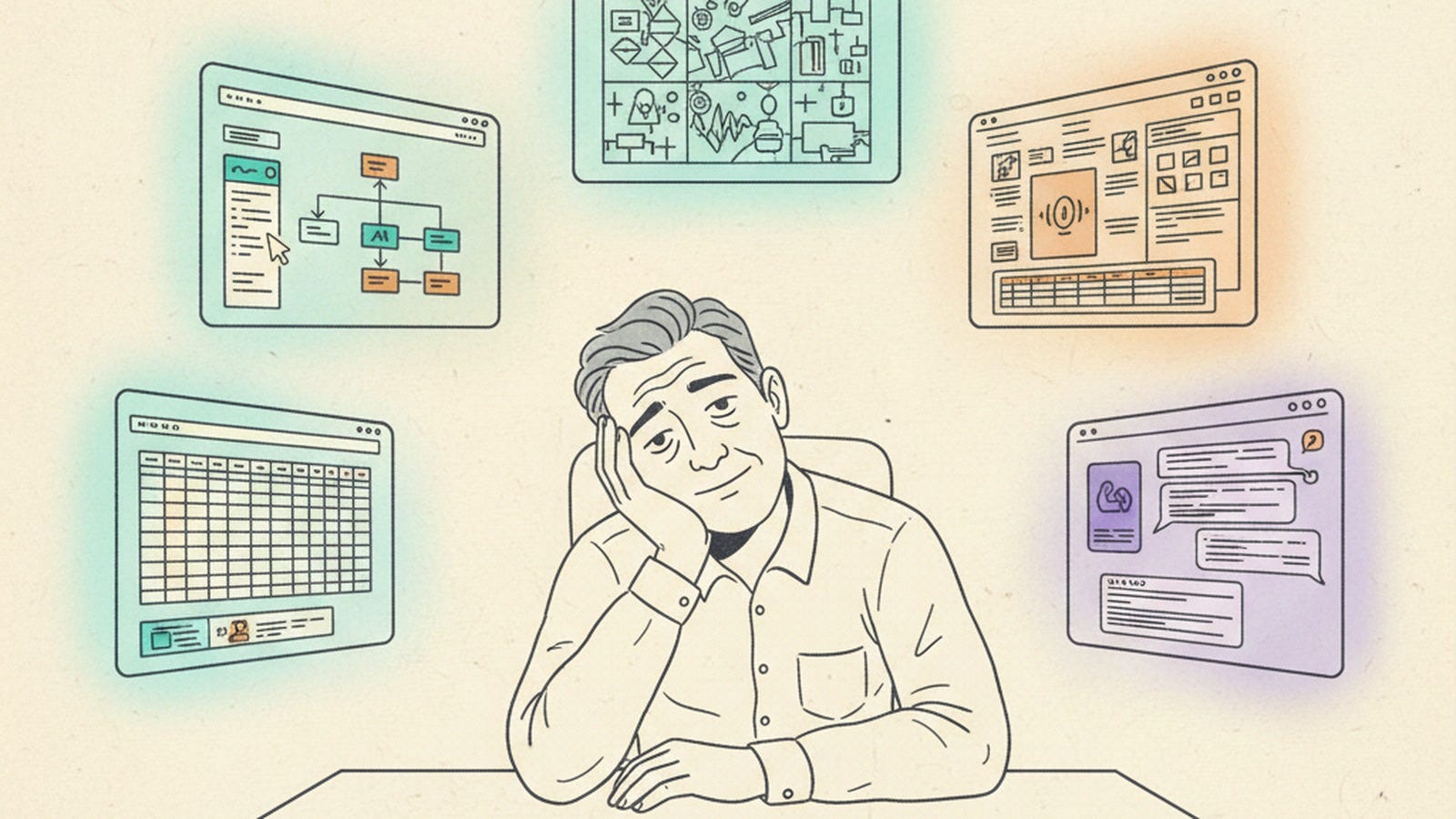
Here’s what most business owners miss about a second or third AI initiative: it’s not a fresh start. It’s a credibility problem. Every failed rollout before this one has trained your employees to wait you out. They’ve learned that if they nod along in the meeting, do the minimum required during launch week, and keep their heads down - the whole thing will fade away on its own.
And honestly? They’re not wrong to think that. According to BCG, roughly 97% of enterprises have struggled to demonstrate real business value from their early AI efforts. Your employees have lived that statistic. They don’t need to read it.
The wall you’re walking into
The resistance you’ll face isn’t laziness and it isn’t fear of technology. It’s something more stubborn: learned skepticism.
A Lark survey published this week found that workplace tool fatigue is one of the primary barriers slowing AI adoption across companies that have already attempted rollouts. And an Ipsos survey from June 2026 found that 38% of American workers aren’t using AI at work at all - with that number jumping to 59% among workers over 55. These aren’t people who’ve never heard of AI. These are people who have decided - based on experience - that it’s not worth the effort.
That’s the environment your next rollout is entering.
The typical response from leadership is to make the rollout bigger. More training. A longer rollout timeline. More executive communication. A vendor-sponsored workshop. All of this is well-intentioned and almost none of it works, because it treats the problem as an information gap when the real problem is a trust gap.
Your employees don’t need more information about AI. They need a reason to believe this time is different.
What actually breaks through
There’s one thing that cuts through hardened skepticism faster than any training program: a win they can point to in week one.
Not a projected win. Not a case study from a company in a different industry. A real, concrete, visible improvement to something they actually do - in their first week of using the tool.
This sounds simple. It’s actually the hardest part of any rollout, because it requires you to do real work before the launch. Specifically:
Pick one workflow, not five. Most rollouts fail because they’re too broad. Leadership wants to show ROI across departments, so they deploy the tool everywhere at once. Nobody gets good at it. Nobody sees a meaningful improvement. Pick the single workflow where the tool can make the most obvious difference and focus there first.
Find your willing early users. Every team has one or two people who are quietly curious about AI and not burned out on it yet. Find them. Let them use the tool for two or three weeks before the broader rollout. Let them work out the kinks. And critically - let them be the ones who demo it to their colleagues. Peer credibility beats management credibility every time after a failed rollout.
Define what “working” looks like in week one. If you can’t answer the question “how will my employees know this is helping them by Friday of week one?” - you’re not ready to launch. Set a specific, observable benchmark. Time saved on a specific task. A report that used to take three hours taking thirty minutes. Something measurable and fast.
Skip the two-hour training. I know this sounds backwards. But a long training session signals that this is a big, complicated thing - which triggers the same skepticism that killed your last rollout. A fifteen-minute “here’s the one thing you’ll do differently starting today” is more effective. You can layer in advanced training later, after people have already seen that the tool works.
The 70% rule
Boston Consulting Group’s research on successful AI transformations found that the companies who get this right allocate 70% of their effort to the people side - upskilling, process change, and culture - and only 30% to the technology itself.
Most businesses do this backwards. They spend 90% of their time and budget selecting and implementing the tool, and about 10% on the people who have to use it. Then they’re surprised when adoption is poor.
If you’re planning a rollout right now, do a quick gut check: of everything you’ve spent time on in the last month related to this project, what percentage was technology evaluation versus people planning? If your answer is heavily weighted toward the technology, you’re building toward another failure.
A different kind of launch
The businesses that are making AI stick right now are treating launch week less like a product release and more like a proof of concept - for their own employees.
They’re saying, in effect: “We know you’ve seen this before. We’re not asking you to take our word for it. Here’s what this tool is going to do for you by the end of this week. If it doesn’t do that, tell us and we’ll fix it.”
That’s a very different conversation than “here’s your new tool, training is on Tuesday.”
The credibility deficit your employees have built up from past failed rollouts is real. It’s not going away on its own. The only thing that closes that gap is a fast, visible, undeniable win.
Everything else is noise.
At Black&Tan Labs, we help SMBs and mid-size companies implement AI in a way that actually sticks - starting with the workflow that makes the most sense for your team. If you’ve had a rollout fall flat and you’re trying to figure out how to approach the next one differently, that’s exactly what we do. Reach out at blackandtanlabs.com
Enjoyed this? New essays on AI, operations, and building in contrast - delivered to your inbox.
Subscribe on Substack →