


The AI Agent That's Already in Your Dashboard
HubSpot, Shopify, and Salesforce just made AI agents default for SMBs. Most owners haven't noticed yet.
Here’s a scenario I keep hearing from business owners in Chicago and across the midwest:
“I know I should be doing something with AI. I’ve tried ChatGPT. My team uses it for writing emails. But I don’t have a developer, I don’t have an IT budget, and I’m not about to sign up for another monthly SaaS subscription I barely understand.”
If that sounds familiar, here’s the news most business owners have missed: the AI agents have already arrived in the tools you’re already paying for. You don’t need to buy anything new. You don’t need to hire anyone. You need to look at what’s already sitting in your dashboard.
In the last 60 days, three of the most widely used SMB platforms - HubSpot, Shopify, and Salesforce - all made major moves that change the AI adoption calculus for small and mid-size businesses. Taken together, they signal that the AI agent era for SMBs isn’t coming. It’s here. And it’s probably already installed on your account.
HubSpot Breeze: Paying for outcomes, not infrastructure
HubSpot’s Breeze suite is the clearest signal yet that platform AI is shifting from “premium add-on” to “default capability.” The company launched its Customer Agent and Prospecting Agent with specific, measurable results across more than 8,000 activations: a 65% conversation resolution rate and issues handled 39% faster than previous workflows. Prospecting Agent activations grew 57% quarter-over-quarter in Q1 2026.
But the real news came on April 14, when HubSpot introduced outcome-based pricing. Instead of charging for compute credits or usage time - the model that makes AI costs unpredictable and scary for SMBs - HubSpot now charges $0.50 per resolved customer conversation and $1 per lead recommendation. That’s it.
Think about what that does to the adoption barrier. Sixty-one percent of small businesses cite cost uncertainty as their primary reason for not adopting AI, according to OECD research. A pay-per-outcome model converts an open-ended infrastructure spend into a predictable cost that behaves more like hiring a contractor than paying for a server you don’t understand. You pay when it works. You don’t pay when it doesn’t.
Shopify Sidekick: The agent that requires zero decisions
For the 4.8 million merchants on Shopify, the AI agent conversation never happened. It was simply turned on.
Sidekick ships with every Shopify subscription at no additional cost. It’s embedded in the admin dashboard. It doesn’t ask merchants to configure workflows or connect APIs. It monitors store data proactively and surfaces personalized recommendations - flagging inventory trending toward stockout, identifying products that perform below category benchmarks, and drafting responses to common customer questions.
The results are concrete: merchants report saving 5 to 10 hours per week, representing $13,000 to $26,000 per year in recovered owner time at a $50 effective hourly rate. Winter ‘26 Edition added Sidekick Pulse, a proactive analysis layer that identifies growth opportunities based on store-specific patterns. Conversion rate improvements of up to 40% have been cited in merchant case studies.
The Shopify example illustrates a broader truth about SMB AI adoption: the most impactful agents are the ones that require zero setup. When the barrier to entry is “log into your dashboard,” adoption becomes a default rather than a decision.
Salesforce Agentforce: The AI paywall is breaking
Salesforce made what might be the most strategically significant move of the three. In March 2026, it embedded Agentforce directly into its Free, Starter, and Pro SMB tiers with no additional SKUs, no setup requirements, and no consumption pricing. Every customer at those tiers now gets AI record summaries, a “Do This Next” recommended action feed, and automated opportunity updates.
The strategic logic is straightforward: if AI becomes a baseline expectation rather than a premium feature, every platform that still charges extra for it faces competitive erosion. Salesforce is betting that making AI table stakes at entry-level pricing will deepen platform stickiness and accelerate adoption faster than any sales campaign could.
Across its broader Agentforce customer base, Salesforce reports over $100 million in annualized cost savings and a 34% productivity increase based on customer-reported outcomes. These are enterprise-weighted figures, but the direction of impact applies to smaller deployments too.
What this means for your business
The broader data supports the thesis. A Salesforce survey found that 91% of small and medium businesses that have adopted AI report a direct boost to revenue. Fifty-eight percent save more than 20 hours per month. Sixty-six percent report monthly cost savings between $500 and $2,000. And they accomplished this without hiring a single engineer.
Gartner projects that 40% of SMBs will deploy at least one AI agent by the end of 2026 - up from just 8% at the start of 2025. That’s a five-fold increase in a single year. Research by Intuit and ICIC found that 89% of small businesses are already using some form of AI tool.
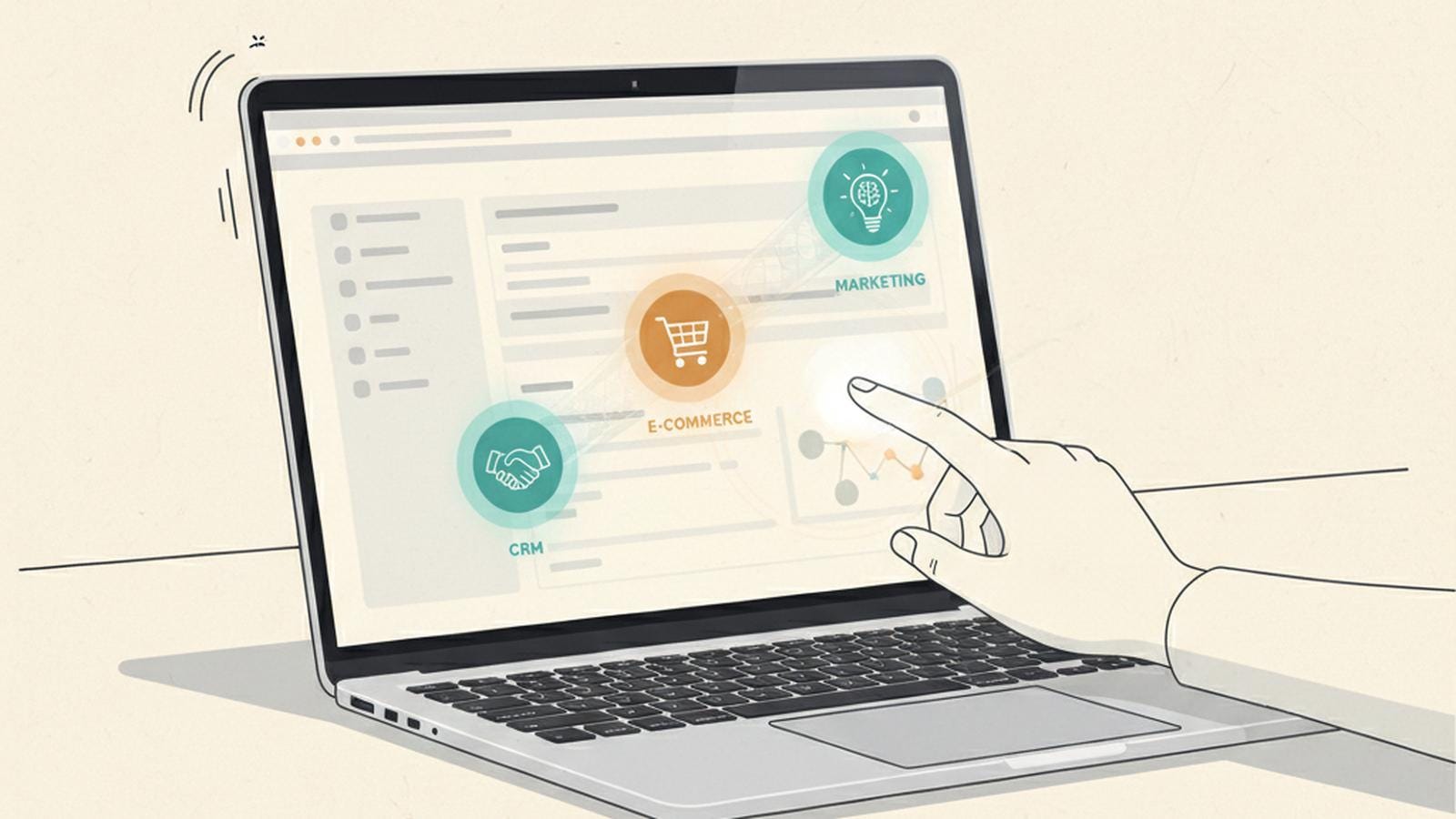
But here’s the catch that all those headlines skip: most SMB owners aren’t adopting AI by seeking it out. They’re stumbling into it because it’s embedded in tools they already have. And that means many of you have AI agents running right now in your CRM, your e-commerce dashboard, or your marketing platform - and you have no idea whether they’re actually working.
That’s the real opportunity. Not deciding whether to adopt AI. You already have. The question is whether you’re managing it.
Most SMBs I talk to are in what I call “AI default mode” - they have agents activated (usually by their platform or by a previous admin) but nobody is monitoring performance, tweaking configurations, or aligning the agent behavior with actual business goals. The agent runs. It resolves conversations. It generates leads. But is it resolving the *right* conversations? Is it generating *qualified* leads? Nobody knows.
For a business owner, the gap between “we have AI” and “we have AI that actually moves the needle” is the difference between a tool on the shelf and a tool that pays for itself. And in 2026, with the economics shifting toward pay-per-outcome, that gap is the single most important thing to close.
The takeaway
You don’t need to build an AI strategy from scratch. You don’t need to evaluate foundation models or hire ML engineers. The strategy that matters right now is simpler: audit what’s already running in your existing platforms. Turn on the agents you’re paying for but haven’t activated. Set up basic monitoring to answer one question - “is this thing actually helping or just running?” - and tweak from there.
That’s where the ROI is. Not in the next model release. Not in the hype cycle. In the agent that’s already in your dashboard, doing its job, waiting for someone to notice.
If you’re not sure where to start or what’s already running in your stack, that’s exactly the kind of thing we help with at Black & Tan Labs. A two-hour Discovery engagement to audit your current tooling, identify the embedded agents you’re not using, and set up the basic monitoring that turns “AI as experiment” into “AI as ROI.” Book it. It’s worth the time.
Enjoyed this? New essays on AI, operations, and building in contrast - delivered to your inbox.
Subscribe on Substack →