


Why Two Companies Can Buy the Same AI and Get Completely Different Results
The tool isn’t the variable. Here’s what is.
Two companies buy the same AI tool. Same vendor, same features, same pricing tier. Six months later, one of them is reporting meaningful productivity gains. The other is shrugging. The tool didn’t change. So what did?
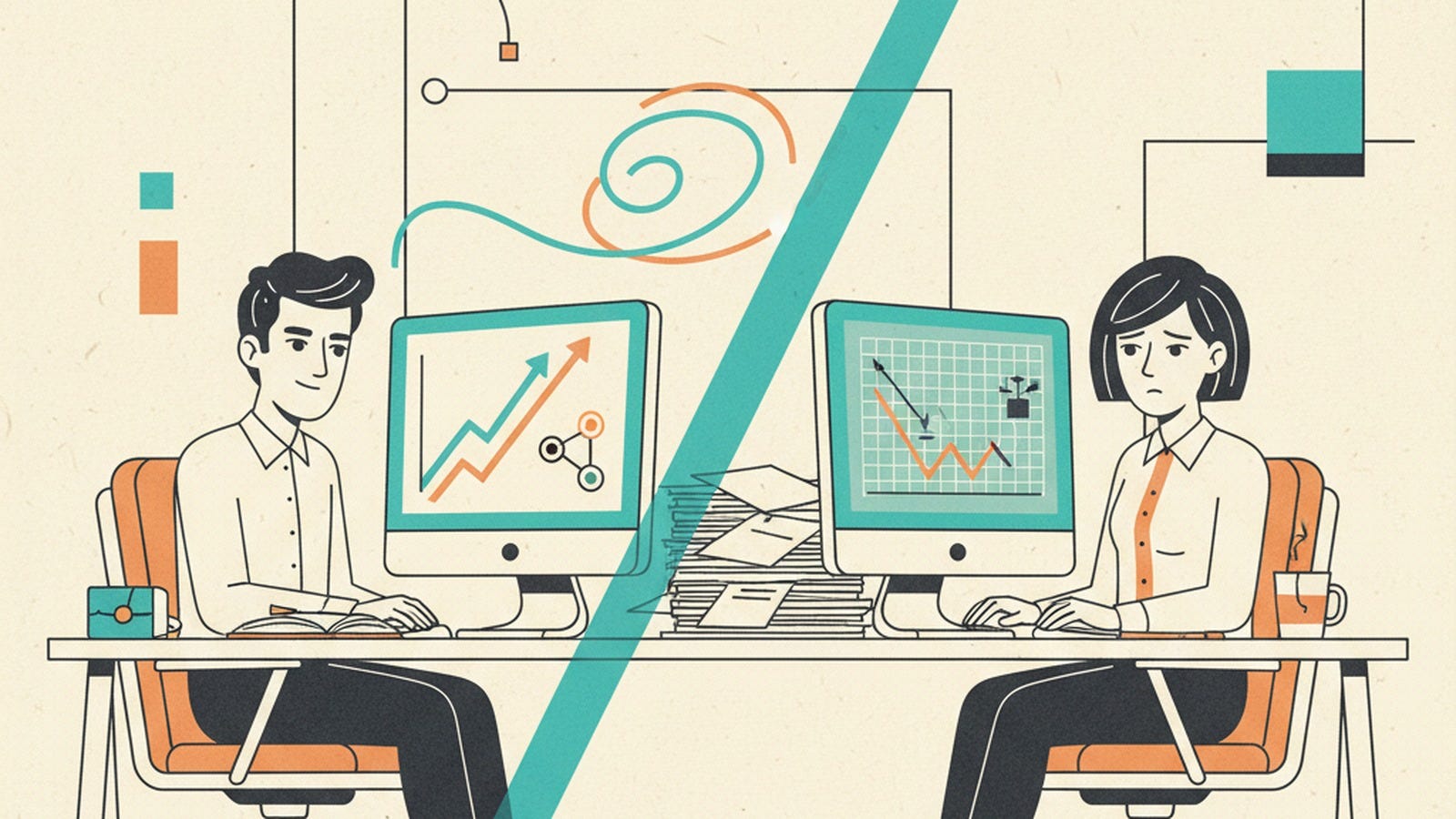
This isn’t a hypothetical. McKinsey has been tracking AI adoption outcomes across industries and the spread is striking: companies doing the implementation work are seeing 15-40% productivity gains. Companies that just turned on licenses are seeing noise. Same tools. Wildly different results.
If you’re a founder or ops lead watching this play out and trying to figure out which camp you’re in, that spread is the only number worth paying attention to right now.
The Access Problem Is Solved
For a long time, the main friction in AI adoption was cost and access. Enterprise tools were priced for enterprise budgets. Small and mid-size businesses either couldn’t justify the spend or were stuck on lower tiers that didn’t include the features worth having.
That’s largely over. Google recently folded AI features into standard Workspace subscriptions, which means a large chunk of the SMB market now has a capable AI toolkit with no incremental cost. The barrier isn’t access anymore.
This is good news. It’s also a trap.
When a tool is free or already paid for, the natural move is to turn it on and see what happens. Announce it to the team. Maybe send a “here’s your new AI assistant” email. Then wait for the productivity gains to show up.
They don’t. Or they do, but unevenly - a few people adopt it enthusiastically, most go back to their old workflows inside a week, and the company ends up in the 15% bucket wondering what they missed.
The Workflow Gap
What separates the 40% outcome from the 15% outcome is whether someone sat down before rollout and mapped the tool to actual work.
The tool doesn’t know your business. It doesn’t know which tasks eat 40% of your ops manager’s week, or where your sales team loses time between CRM updates. That work has to be done by a human, before the tool goes live.
This isn’t complicated, but it takes time and honest attention. It means pulling up the messy middle of how work actually happens - not how it’s supposed to happen - and identifying where the AI can create a real handoff. A first draft that a human refines rather than a human writing from scratch. A data pull that takes 30 minutes automated instead of 2 hours manual. A summary layer that gets the right information to the right person faster.
These aren’t hypotheticals. They’re the specific use cases that produce the 40% outcomes. The difference is that someone found them before the rollout, not after.
The Rollout Order Problem
Most AI rollouts happen in the wrong order. The tool goes live, then people figure out what to do with it. The higher-performing implementations flip this sequence.
Before rollout: pick 2-3 workflows that have real friction and real volume. Map how the AI fits into each one. Write a simple protocol for how the team should use it in those specific contexts. Test it with one person first.
After rollout: expand from what’s working. Let the concrete wins create adoption pull, rather than announcing a mandate and hoping for uptake.
This isn’t a complicated change management program. It’s a sequencing fix. The companies landing at the high end of the McKinsey spread didn’t necessarily have better change management or more sophisticated AI strategies. They did the pre-work first.
Maintenance Is the Other Half
Implementation isn’t a one-time event. This is the part that’s almost never discussed when AI tools get announced.
Workflows shift. The AI tools themselves get updated - sometimes significantly. The prompt that worked three months ago stops working. A new feature ships that’s actually useful for something specific to your business, but nobody notices because there’s no one watching.
The 40% outcome isn’t a destination. It’s a maintained state.
The businesses that sustain high performance after an AI rollout have someone - an internal owner, an outside partner, someone - keeping their automations current. Not spending hours on it every week. But not ignoring it either. A regular check-in cadence, patches when things drift, and attention when the tools themselves change.
This is boring work. It’s also the work that separates a durable efficiency gain from a productivity spike that fades out by Q3.
The Real Variable
Here’s the reframe: AI tool selection is almost never the reason a rollout succeeds or fails. The vendor landscape has gotten competitive enough that most serious tools are capable enough. What fails is the assumption that a good tool deploys itself.
The companies in the 40% bucket made a different bet. They bet that someone’s time, spent upfront on workflow mapping and rollout design, was worth the investment. They were right. The McKinsey spread is basically a measure of how many organizations made that bet versus how many just turned on licenses.
Access to AI is now commoditized. Knowing what to do with it - before you turn it on - isn’t.
If you’re at the stage where your AI stack is either about to go live or has already gone live without the pre-work, Black&Tan Labs runs a structured Discovery engagement - a full day, in-person, at $10k - that does exactly this workflow mapping work. For teams that already have automations running and need someone keeping them current, the Care & Feeding portion at $500/month per automation handles the maintenance layer. Neither is a program. Both are practical.
Enjoyed this? New essays on AI, operations, and building in contrast - delivered to your inbox.
Subscribe on Substack →