


Your AI Agent Failed Because You Never Fixed the Workflow
Most businesses will waste money on AI agents this year - not because the agents don’t work, but because they’re bolting them onto processes that were already broken.
You know the pattern. Someone hears about AI agents handling customer service or qualifying leads. They spin up a pilot. It works in the demo. Then it hits your actual workflow and everything stalls. The agent produces outputs no one reviews. It needs exceptions no one planned for. Three months later, you’ve got another tool gathering dust and a team that’s even more skeptical than before.
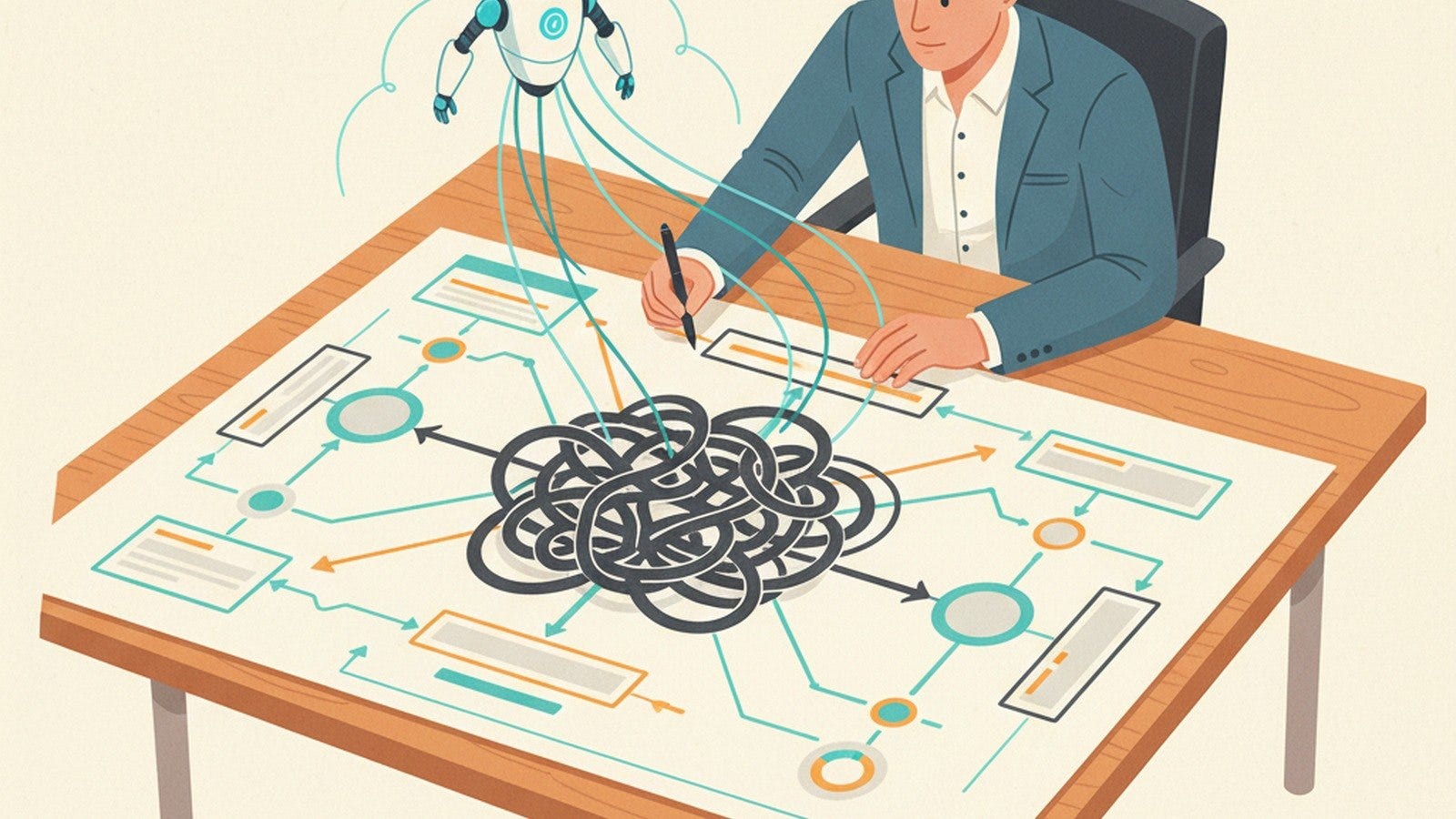
The problem isn’t the technology. It’s that you automated a mess.
The Adoption Wave Is Here, and Most Companies Aren’t Ready
Gartner forecasts that 40% of enterprise applications will embed AI agents by the end of 2026, up from less than 5% in 2025. That’s not a gradual shift. That’s a land rush.
But here’s what the numbers don’t show in the headlines: 88% of AI agent projects never make it to production. A March 2026 survey of 650 enterprise tech leaders found that 78% had at least one AI agent pilot running, but only 14% reached production scale. And according to MIT NANDA research, 95% of generative AI pilots fail to deliver measurable business impact.
The gap between “we tried AI” and “AI is working” is enormous. And it’s not because the models are bad. It’s because most companies are doing this backward. They’re buying the tool before defining the workflow it should improve.
Tool-First Adoption Is a Trap
The most common failure mode we see is simple: someone decides they need an AI agent, picks a platform, and then tries to figure out where to use it. That’s like buying a forklift and then walking around the warehouse looking for things to lift.
When you start with the tool, you end up forcing it into processes that weren’t designed for it. Maybe your lead follow-up workflow has seven different handoffs depending on deal size, industry, and whether the prospect mentioned a competitor. Maybe your customer service process requires pulling data from three systems that don’t talk to each other, plus a judgment call about whether to escalate.
An AI agent can technically handle pieces of that. But if the underlying process is tangled, the agent inherits the tangle. And now you’ve got a black box making decisions inside a process no one fully understood in the first place. That’s when trust collapses and adoption dies.
No One Changed Who Does What
Even when the agent works technically, there’s a failure pattern that kills ROI: no one redesigned the handoffs. The AI produces outputs - summaries, draft responses, qualified leads - but the same people are still doing the same reviews in the same way. Nothing actually got faster or cheaper.
We’ve seen this repeatedly. A company deploys an agent to handle tier-1 customer service questions. The agent answers correctly. But because no one changed the escalation protocol, a human still reviews every answer before it goes out. The agent saved zero time. It just added a step.
Or an agent qualifies inbound leads and updates the CRM. Great. But the sales team still treats every lead the same way because they don’t trust the scoring yet, and no one built a feedback loop to improve it. The agent runs. No one changes behavior. No value gets captured.
The fix isn’t a better agent. It’s defining, before you deploy anything, who stops doing what and who starts doing something new. If the answer is “no one,” you’re not ready.
What Actually Works (and What Doesn’t)
AI agents work when the workflow is clean and the handoffs are clear. Customer service is a great fit if you can define tier-1 FAQs, appointment changes, and simple account updates - and if you trust the agent to handle them without review. Lead follow-up works if you can articulate what “qualified” means and you’re willing to let the agent respond in minutes, not hours.
Document and admin work - invoicing, scheduling, basic data entry - works because the process is repetitive and the exceptions are rare. These aren’t glamorous use cases, but they’re the ones that hit production and stay there.
What doesn’t work: broad, ambiguous processes with no clear boundaries. Exception-heavy workflows where “it depends” is the most common answer. Anything where the humans involved can’t describe the process in under five minutes. If you can’t map it, you can’t automate it.
And this is the part most companies skip. They assume the workflow is fine because it’s been running for years. But “running” and “well-designed” are not the same thing. Most workflows evolved through accumulated workarounds, undocumented exceptions, and “Jane just knows how to handle that” tribal knowledge. An AI agent can’t learn that. And even if it could, you shouldn’t want it to.
Fix the Process, Then Add the Agent
The companies that will win with AI agents this year aren’t the ones with the biggest budgets or the fanciest tools. They’re the ones who do the boring work first. They map the workflow. They identify the handoffs. They decide what success looks like and who needs to change their behavior for it to happen.
Then they pick the agent. And when they do, it works - because they built a process that was ready for it.
The agent adoption wave is real. But speed without preparation just means you’ll hit the wall faster. The fix is simple. It’s just not sexy. Clean up your workflows before you automate them.
If you want to figure out which of your workflows are actually agent-ready - and which ones will fail if you skip the prep work - that’s exactly what our Discovery call is for. Free, thirty minutes, no pitch. Just your problem and whether AI actually helps. Book it at blackandtanlabs.com.
Enjoyed this? New essays on AI, operations, and building in contrast - delivered to your inbox.
Subscribe on Substack →